

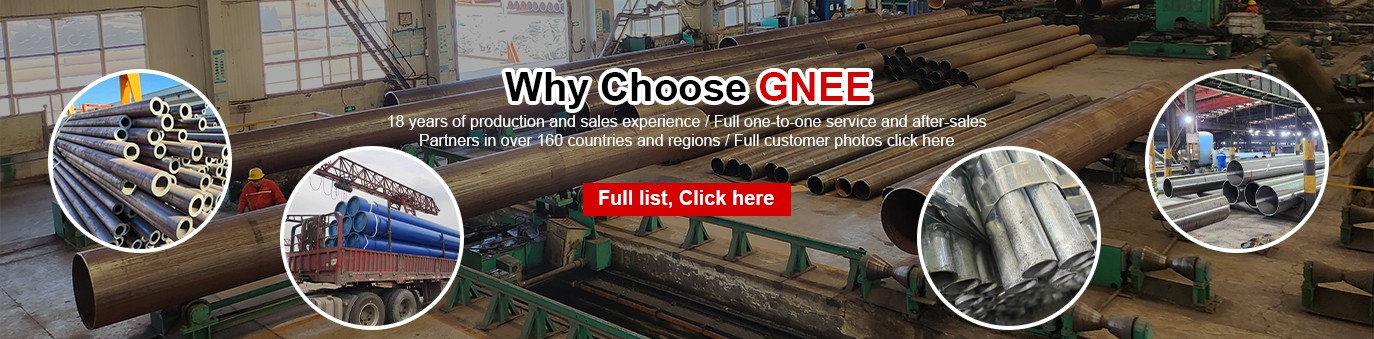
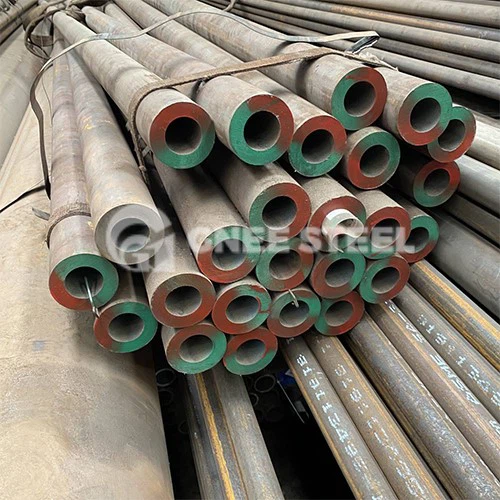
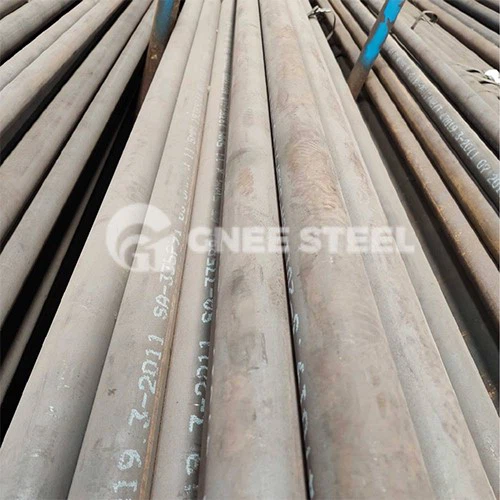
A335 P91 Alloy Pipe
Mar 15, 2024
- A335 P91 alloy tube application
It can be used as steel pipes for high-temperature superheaters and reheaters of subcritical and supercritical boilers with wall temperatures ≤625°C, as well as high-temperature headers and steam pipes with wall temperatures ≤600°C. It can also be used as nuclear power heat exchangers and petroleum cracking unit furnace tubes.
Standard: ASTM A213 ASTM A335
Tensile strength: ≥585 (MPa)
Yield strength: ≥415 (MPa)
Elongation: ≥20 (%)
P91 steel is a new type of martensitic heat-resistant steel jointly developed by the National Xiangshuling Laboratory and the Metallurgical Materials Laboratory of Combustion Engineering Corporation of the United States. It is based on 9Cr1MoV steel to reduce the carbon content, strictly limit the sulfur and phosphorus content, and add a small amount of vanadium and niobium elements for alloying. According to ASTM213/A213M-85C, the chemical composition of P91 steel is shown in Table 1.
The German steel number corresponding to P91 steel is X10CrMoVNNb91, the Japanese steel number is HCM95, and the French steel number is TUZ10CDVNb0901.
-
The role of each alloying element in A335 P91
They respectively play the role of solid solution strengthening, dispersion strengthening and improving the oxidation resistance and corrosion resistance of steel. The specific analysis is as follows.
① Carbon is the element with the most obvious solid solution strengthening effect in steel. As the carbon content increases, the short-term strength of the steel increases, and the plasticity and toughness decrease. For martensitic steels such as P91, the increase in carbon content will Accelerate the spheroidization and aggregation rate of carbides, accelerate the redistribution of alloy elements, and reduce the weldability, corrosion resistance and oxidation resistance of steel. Therefore, heat-resistant steel generally hopes to reduce the carbon content, but if the carbon content is too low, the steel's Intensity will be reduced. Compared with 12Cr1MoV steel, P91 steel has a 20% lower carbon content, which is determined by comprehensively considering the above factors.
②P91 steel contains trace amounts of nitrogen, and the role of nitrogen is reflected in two aspects. On the one hand, it plays the role of solid solution strengthening. The solubility of nitrogen in steel at room temperature is very small. During the welding heating and post-weld heat treatment processes in the post-weld heat affected zone of P91 steel, the solid solution and precipitation processes of VN will occur successively: During welding heating The nitrogen content of the austenite structure formed in the heat affected zone increases due to the dissolution of VN. After that, the degree of supersaturation in the normal temperature structure increases, and fine VN precipitates during the subsequent post-weld heat treatment, which increases the structural stability. , improving the lasting strength value of the heat affected zone. On the other hand, P91 steel also contains a small amount of A1, and nitrogen can form A1N with it. A1N only dissolves into the matrix in large quantities above 1100°C, and re-precipitates at lower temperatures, which can achieve a better dispersion strengthening effect.
③ Adding chromium is mainly to improve the oxidation resistance and corrosion resistance of heat-resistant steel. When the chromium content is less than 5%, violent oxidation begins at 600°C, and when the chromium content reaches 5%, it has good oxidation resistance. 12Cr1MoV steel has good oxidation resistance below 580℃, with a corrosion depth of 0.05 mm/a. Its performance begins to deteriorate at 600℃, with a corrosion depth of 0.13 mm/a. The chromium content of P91 is increased to about 9%, and the service temperature can reach 650°C. The main measure is to dissolve more chromium in the matrix.
④ Vanadium and niobium are both strong carbide-forming elements. When added, they can form fine and stable alloy carbides with carbon, which have a strong dispersion strengthening effect.
⑤The main purpose of adding molybdenum is to improve the thermal strength of steel and play the role of solid solution strengthening.
A335 P91 alloy tube heat treatment process
The final heat treatment of P91 is normalizing + high temperature tempering. The normalizing temperature is 1040℃, the holding time is not less than 10 min. The tempering temperature is 730~780℃, the holding time is not less than 1h. The structure after the final heat treatment is tempered. Fire martensite.
A335 P91 alloy tube mechanical properties
The normal temperature tensile strength of P91 steel is ≥585 MPa, the normal temperature yield strength is ≥415 MPa, the hardness is ≤250 HB, the elongation (standard circular specimen with 50 mm gauge) is ≥20%, and the allowable stress value [σ] is 650 ℃=30 MPa.
According to the carbon equivalent formula recommended by the International Welding Society, the carbon equivalent of P91 is 1.631, and the weldability of P91 is poor.
- Problems when welding A335 P91
1. Generation of hardened structure in heat-affected zone
The critical cooling rate of P91 is low and the austenite stability is great. Normal pearlite transformation is not easy to occur during cooling, so martensite transformation occurs when cooling to a lower temperature. Because of this, P91 has a great tendency to harden and cold crack.
Since various tissues in the heat-affected zone have different densities, expansion coefficients and different lattice forms, they will inevitably be accompanied by different volume expansion and contraction during the heating and cooling processes; on the other hand, due to the uneven and Due to the high temperature, the internal stress of the P91 welded joint is very large.
For P91, austenite is very stable and needs to be cooled to a lower temperature (about 400°C) to change into martensite. The coarse martensite structure is brittle and hard, and the joints are under complex stress conditions. At the same time, during the cooling process of the weld, hydrogen diffuses from the weld to the near-seam area. The presence of hydrogen promotes martensite embrittlement. As a result of its combined effects, cold cracks are easily generated in the quenching zone.
2. Grain growth in heat affected zone
The welding thermal cycle has a significant impact on the grain growth in the heat-affected zone of the welding joint, especially the fusion zone adjacent to the highest heating temperature. When the cooling rate is small, coarse massive ferrite and carbide structures will appear in the welding heat-affected zone, which will significantly reduce the plasticity of the steel; when the cooling rate is large, due to the generation of coarse martensite structure, the plasticity of the steel will also be reduced. The plasticity of welded joints decreases.
3. Generation of softening layer
When P91 steel is welded in a quenched and tempered state, it is inevitable to produce a softening layer in the heat-affected zone, and the softening is more serious than that of pearlitic heat-resistant steel. When the heating and cooling speeds are slower, the degree of softening is greater. In addition, the width of the softened layer and its distance from the fusion line are not only related to the heating conditions and characteristics of the welding, but also related to preheating, post-weld heat treatment, etc.
4. Stress corrosion cracking
Before the post-weld heat treatment of P91 steel, the cooling temperature is generally not lower than 100°C. If it is cooled at room temperature and the environment is relatively humid, stress corrosion cracking will easily occur. German regulations: it must be cooled to below 150°C before post-weld heat treatment. When the workpiece is thick, has fillet welds, and has poor geometric dimensions, the cooling temperature should not be lower than 100°C. If it is cooled at room temperature, it is strictly prohibited to be wet, otherwise stress corrosion cracking will easily occur.


