

Cryogenic Tube
Jan 29, 2024
Low Temperature Steel Pipe Supplier-GNEE
Low temperature steel pipe
Implementation standards: GB/T18984-2003, ASTM A333
Spot specifications: 8-1240×1-200mm<1/8"-48"×SCH5S-SCH160, STD, XS, XXS>
Product material:, 10MnDG, 09DG, 09Mn2VDG, 06Ni3MoDG,
ASTM A333-Grade1, Grade3, Grade4, Grade6, Grade7, Grade8, Grade9,
Grade10,Grade11
Product application: Suitable for -45℃~-195℃ low-temperature pressure vessel pipes and seamless steel pipes for low-temperature heat exchanger pipes
Production process: cold drawing and hot rolling
Microstructure
The quenching temperature of low-temperature steel pipes is A3+(30~50)℃. In actual operation, the upper limit is generally taken. A higher quenching temperature can speed up the heating speed of low-temperature steel pipes, reduce surface oxidation, and improve work efficiency. In order to homogenize the austenite of the workpiece, sufficient holding time is required. If the actual furnace load is large, the holding time needs to be appropriately extended. Otherwise, insufficient hardness may occur due to uneven heating. However, if the holding time is too long, coarse grains and serious oxidative decarburization will also occur, which will affect the quenching quality. We believe that if the furnace loading capacity is greater than the stipulations in the process documents, the heating and holding time needs to be extended by 1/5.

Because the low-temperature steel pipe has low hardenability, a 10% brine solution with a high cooling rate should be used. After the workpiece enters the water, it should be quenched through, but not cooled through. If the 45# precision steel pipe is cooled through in salt water, it may cause the workpiece to crack. This is because when the workpiece is cooled to about 180°C, austenite quickly transforms into martensite. Temperature caused by excessive organizational stress. Therefore, when the quenched low-temperature steel pipe is quickly cooled to this temperature range, a slow cooling method should be adopted. Since the temperature of the outlet water is difficult to control, it must be operated based on experience. When the workpiece in the water stops shaking, the water can be outlet for air cooling (it would be better if it can be oil-cooled). In addition, when the workpiece enters the water, it should be moved rather than static. It should move regularly according to the geometric shape of the workpiece. The static cooling medium plus the static workpiece leads to uneven hardness and uneven stress, which causes the workpiece to deform greatly and even crack.
The hardness of low-temperature steel pipe quenched and tempered parts after quenching should reach HRC56~59. The possibility of larger cross-sections is lower, but it cannot be lower than HRC48. Otherwise, it means that the workpiece has not been completely quenched, and sorbite or even ferrite may appear in the structure. The structure remains in the matrix after tempering and cannot achieve the purpose of tempering.
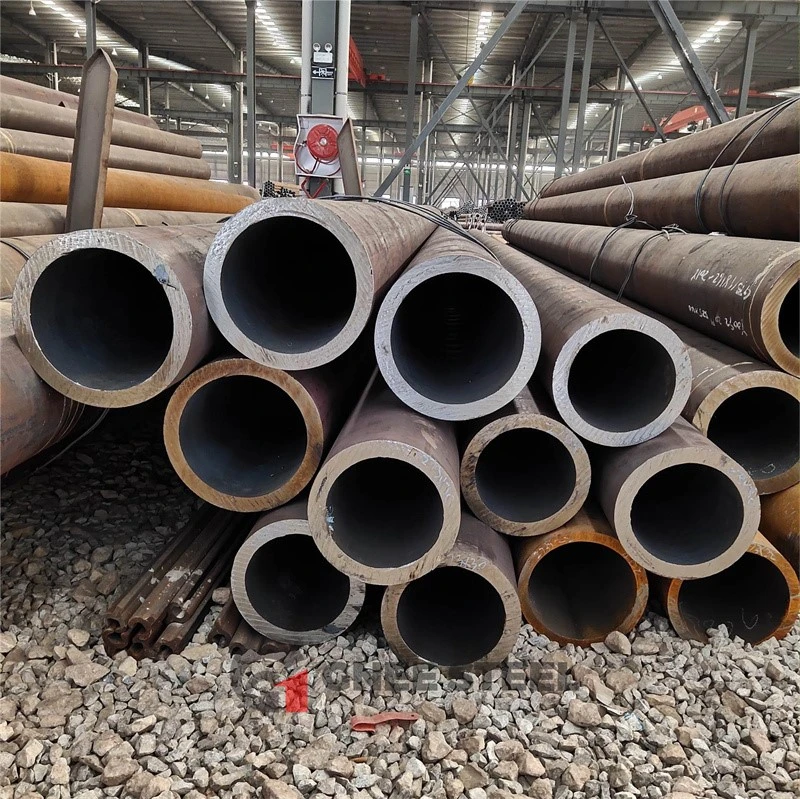
For high-temperature tempering after quenching of low-temperature steel pipes, the heating temperature is usually 560~600℃, and the hardness requirement is HRC22~34. Because the purpose of tempering is to obtain comprehensive mechanical properties, the hardness range is relatively wide. However, if the drawing has hardness requirements, the tempering temperature must be adjusted according to the drawing requirements to ensure the hardness. For example, some shaft-type low-temperature steel pipes require high strength and high hardness requirements; while some gears and shaft parts with keyways need to be milled and inserted after tempering, so the hardness requirements are lower. Regarding the tempering and holding time, it depends on the hardness requirements and the size of the workpiece. We believe that the hardness after tempering depends on the tempering temperature and has little to do with the tempering time, but it must be tempered. Generally, the tempering and holding time of the workpiece is always More than an hour.


