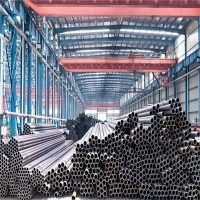
25CrMo4 Seamless Pipe: Composition, Heat Treatment and Mechanical Data
Feb 28, 2024
25CrMo4 is a chromium molybdenum alloy steel used where a plain carbon pipe cannot hold the strength or the fatigue life that the duty demands. It combines moderate hardenability with good toughness after tempering, so it is supplied as seamless pipe in the quenched and tempered condition for high pressure lines, and as bar or tube for fasteners, shafts, gears and other carburised parts. The grade is standardised as material number 1.7218, and its chemistry is close to the chromium molybdenum family used for aircraft and machine parts, which is why it is common in hydraulic and mechanical tubing as well as in process piping.
Chemical Composition of 25CrMo4
| Element | Min, percent | Max, percent |
|---|---|---|
| Carbon | 0.22 | 0.29 |
| Silicon | 0.10 | 0.40 |
| Manganese | 0.60 | 0.90 |
| Phosphorus | - | 0.035 |
| Sulfur | - | 0.035 |
| Chromium | 0.90 | 1.20 |
| Molybdenum | 0.15 | 0.30 |
Carbon across 0.22 to 0.29 percent gives the hardenability of the grade, chromium from 0.90 to 1.20 percent supports both strength and scaling resistance, and molybdenum from 0.15 to 0.30 percent raises the tempering resistance so that strength is retained at working temperature. Silicon is present between 0.10 and 0.40 percent as a deoxidation residue. Phosphorus and sulfur are each capped at 0.035 percent, and cleaner steelmaking practice with sulfur held near 0.010 percent is preferred for pipe that will see impact loading or cold forming, because inclusions act as crack initiation sites in a quenched and tempered structure.
Heat Treatment Routes
| Treatment | Temperature | Cooling | Purpose |
|---|---|---|---|
| Soft annealing | 680 to 720 degrees Celsius | Furnace cooling | Lowest hardness for machining and cold forming |
| Normalising | 870 to 900 degrees Celsius | Still air | Refine grain size and even out the structure before hardening |
| Hardening | 850 to 880 degrees Celsius | Oil or water quench, polymer where distortion is critical | Full martensitic structure and peak hardness |
| Tempering | 540 to 660 degrees Celsius | Air cooling | Trade strength against toughness for the required duty |
| Stress relief | 600 to 650 degrees Celsius | Furnace or air cooling | Reduce residual stress after welding or forming |
Two practical points govern the whole process. First, cooling after normalising is done in air, not in water or oil; only hardening calls for a fast quench, and treating the two operations as if they were the same causes quench cracks and distorted pipe. Second, the tempering temperature is the real control on the delivered properties: below about 540 degrees Celsius the steel is strong but notch sensitive, and above 660 degrees Celsius strength falls away with no benefit in service. The exact tempering temperature is normally agreed between the mill and the user so that the finished pipe meets both the tensile and the impact requirement in one heat treatment cycle.
Mechanical and Physical Properties
| Property | Typical value |
|---|---|
| Tensile strength, quenched and tempered | 900 to 1100 MPa |
| 0.2 percent proof strength, quenched and tempered | 700 to 850 MPa |
| Elongation | 12 to 16 percent |
| Impact toughness, Charpy V at room temperature | Determined by the chosen tempering temperature |
| Density | 7.85 g per cubic centimetre |
| Melting range | Approximately 1400 to 1460 degrees Celsius |
| Thermal expansion, 20 to 100 degrees Celsius | About 12.5 x 10⁻⁶ per degree Celsius |
| Thermal conductivity at 20 degrees Celsius | About 42.5 W per metre kelvin |
| Specific heat capacity | About 0.46 J per gram kelvin |
The spread in the strength figures is not a tolerance on the steel itself; it reflects the section size and the tempering temperature chosen. A thin wall tube quenched in oil from the hardening temperature reaches a higher strength than thick wall pipe of the same heat, because the core cools more slowly. Buyers who need one narrow strength window should state a tempering range and expect a hardness check on each lot, since hardness across the wall is the quickest way to confirm that the pipe was through hardened.
Welding, Machining and Supply Conditions
Preheat of about 150 to 200 degrees Celsius on wall thickness above roughly 15 mm, and on any joint where the carbon equivalent is at the top of the range
Low hydrogen consumables for shielded metal arc welding, or a matching chromium molybdenum filler for joints that must carry full parent metal strength
Post weld heat treatment at 600 to 650 degrees Celsius when the wall is thick or the service is cyclic, followed by a hardness check to confirm the heat affected zone has been tempered
Machining in the quenched and tempered condition suits carbide tooling at moderate speed; the soft annealed condition is used when a heavy cut or a forming operation comes first
Delivery conditions: quenched and tempered, normalised, or soft annealed, with the condition stated on the mill certificate together with the heat number and the test results
Frequently Asked Questions About 25CrMo4 Seamless Pipe
Q: What is the difference between 25CrMo4 and plain carbon pipe such as grade 20?
The chromium and molybdenum additions raise hardenability and high temperature strength, so 25CrMo4 can be quenched and tempered to 700 MPa proof strength or more, which a plain carbon grade cannot reach at the same wall thickness.
Q: Why is normalising cooled in air rather than quenched?
Normalising is a grain refining treatment, not a hardening step. Air cooling gives a uniform ferrite and pearlite structure; quenching from the normalising temperature produces martensite, distortion and a real risk of cracking.
Q: Can 25CrMo4 seamless pipe be welded in the field?
Yes, with preheat on thicker walls, low hydrogen consumables and a post weld heat treatment at 600 to 650 degrees Celsius for heavy or cyclic service, followed by hardness verification of the heat affected zone.
Q: What does 1.7218 mean on a mill certificate?
It is the material number for the same grade in the European designation system. A certificate may carry 1.7218 and 25CrMo4 together, and both refer to the same chromium molybdenum steel.
Q: Is 25CrMo4 suitable for low temperature service?
Not in the quenched and tempered condition at very low temperature, because the structure loses toughness. For cold duty a grade with verified impact energy at the design temperature should be ordered instead.
Q: How is the pipe checked before dispatch?
Common checks are spectrochemical analysis of the heat, tensile and hardness testing, ultrasonic or eddy current examination of the body, dimensional inspection, and hydrostatic testing when the pipe is ordered for pressure service.