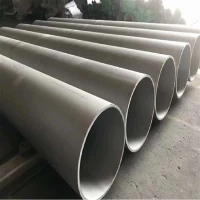
ASTM A209 Carbon-Molybdenum Alloy Steel Boiler Tubes
Jan 10, 2025
What ASTM A209 Material Is
ASTM A209 is the specification for seamless carbon-molybdenum alloy steel boiler and superheater tubes. The grade family discussed here, A209 T1 together with the closely related carbon-molybdenum grades T1a and T1b, is a low-alloy steel in which a controlled molybdenum addition delivers properties that plain carbon steel cannot reach. The material offers high oxidation resistance and good resistance to high-temperature steam corrosion, combined with sound impact toughness and stable long-term plasticity and creep-rupture strength.
In service temperatures below 620 °C, the allowable stress of A209 material is higher than that of austenitic stainless steel. That single property explains its popularity in high-temperature steam circuits: for the same pressure duty, a carbon-molybdenum wall can be thinner and lighter than a stainless wall, with better thermal conductivity and lower thermal expansion mismatch at the tube-to-header joint.
Chemical Composition of A209 Grades
The three grades differ mainly in their carbon range; silicon, manganese, phosphorus, sulphur and molybdenum limits are common across the family. Values are given in percent by weight.
| Grade | C | Si | Mn | P max | S max | Mo |
|---|---|---|---|---|---|---|
| A209 T1 | 0.10-0.20 | 0.10-0.50 | 0.30-0.80 | 0.025 | 0.025 | 0.44-0.65 |
| A209 T1a | 0.15-0.25 | 0.10-0.50 | 0.30-0.80 | 0.025 | 0.025 | 0.44-0.65 |
| A209 T1b | 0.14 max | 0.10-0.50 | 0.30-0.80 | 0.025 | 0.025 | 0.44-0.65 |
The molybdenum content of 0.44 to 0.65 percent is the defining feature of the family. It raises the creep resistance of the steel at elevated temperature, which is what allows the tube wall to carry steam pressure without excessive deformation over a long operating life. Phosphorus and sulphur are each held to 0.025 percent maximum to protect weldability and toughness, and the silicon and manganese ranges are balanced for deoxidation and through-thickness soundness.
Mechanical Properties at Room Temperature
| Grade | Tensile strength (MPa) | Yield point (MPa) | Elongation (%) |
|---|---|---|---|
| A209 T1 | 380 min | 205 min | 30 min |
| A209 T1a | 365 min | 195 min | 30 min |
| A209 T1b | 415 min | 220 min | 30 min |
The lower carbon grade T1b pairs the highest tensile and yield minima with the lowest carbon level, which is why it is often selected where welding is extensive and toughness matters as much as strength. T1 sits in the middle of the family and is the most widely ordered grade, while T1a trades a little room-temperature strength for a higher carbon range.
Why Carbon-Molybdenum Steel Is Chosen
Elevated-temperature strength: the molybdenum addition stabilises the microstructure against softening and creep at steam temperatures, so the tube retains strength where plain carbon steel would relax.
Steam-side corrosion resistance: oxidation resistance and resistance to high-temperature steam attack extend tube life in superheater and reheater service.
Thermal behaviour: because the allowable stress below 620 °C exceeds that of austenitic stainless steel, thinner walls can be used, and thinner walls mean lower thermal stress during start-up and shutdown.
Toughness and ductility: impact toughness is good and the heat-strength properties remain stable over long service exposure, supporting predictable remaining life assessment.
Typical Applications
A209 seamless tubes are used mainly for superheater tubes in utility and industrial boilers, high-temperature superheater and reheater steel pipes, high-temperature header boxes and steam pipes. The same material is also applied to nuclear power heat exchangers and to furnace tubes in oil cracking units, where the combination of steam or process-side corrosion resistance and elevated-temperature strength is required.
Selection and Fabrication Notes
Confirm the grade against the design temperature and pressure before ordering, because T1, T1a and T1b are not interchangeable in a stress calculation.
State the tube dimensions, the ASTM A209 reference and the required heat treatment condition in the purchase specification.
Check mill certificates for the specified carbon range and for the 0.44 to 0.65 percent molybdenum band.
Plan welding procedures with preheat and interpass control appropriate to a low-alloy molybdenum steel, and verify mechanical properties after any repair welding.
Protect tube ends and the bore during transport and storage to avoid corrosion pits that later become stress raisers.
Frequently Asked Questions
Q: What is ASTM A209 material?
It is a seamless carbon-molybdenum alloy steel specification for boiler and superheater tubes, supplied in grades T1, T1a and T1b with 0.44 to 0.65 percent molybdenum.
Q: What is the maximum service temperature of A209 tubes?
The material is applied in service below 620 °C, where its allowable stress is higher than that of austenitic stainless steel.
Q: What is the difference between T1, T1a and T1b?
They differ in carbon content: T1 spans 0.10-0.20 percent, T1a spans 0.15-0.25 percent and T1b is held to 0.14 percent maximum, which also gives T1b the highest minimum tensile and yield strength.
Q: What are the minimum mechanical properties of A209 T1?
Tensile strength 380 MPa minimum, yield point 205 MPa minimum and elongation 30 percent minimum.
Q: Where are A209 tubes used?
In superheater and reheater tubes, high-temperature header boxes and steam pipes of boilers, and in nuclear power heat exchangers and oil cracking furnace tubes.
Q: Why is molybdenum added to A209 steel?
Molybdenum raises creep resistance at elevated temperature, so the tube keeps its strength and shape during long exposure to high-pressure steam.