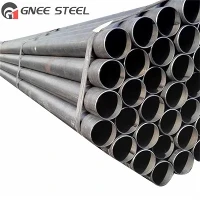
ASTM A192 Seamless Carbon Steel Pipes for High-Pressure Superheater Service
Sep 06, 2023
ASTM A192 (also issued as ASME SA192) is the standard specification for seamless carbon steel boiler and superheater tubes for high-pressure service. Tubes made to this grade are used in superheaters, heat exchangers, condensers and similar heat-transfer equipment where pressure containment, ductility and efficient heat transfer all matter at the same time. Because the product is seamless, there is no longitudinal weld that could act as a weak point or leak path under thermal cycling, and the low-carbon chemistry keeps the tube workable for bending, coiling and tube-sheet expansion.
Typical users are power generation plants, industrial and utility boiler makers, and process industries that need a dependable carbon steel tube for high-pressure circuits where a chromium-molybdenum alloy is not required.
Chemical Composition
Heat analysis and product analysis must both fall within the limits below, expressed in percent by weight.
| Element | Composition, % by weight |
|---|---|
| Carbon (C) | 0.06 - 0.18 |
| Manganese (Mn) | 0.27 - 0.63 |
| Phosphorus (P) | 0.035 max |
| Sulfur (S) | 0.035 max |
Mechanical Properties
| Property | Minimum value |
|---|---|
| Tensile strength | 325 MPa (47,000 psi) min |
| Yield strength | 180 MPa (26,000 psi) min |
| Elongation in 50 mm | 35% min |
| Hardness | HRB 77 max |
The values apply to the finished tube after final heat treatment. Hardness is deliberately capped so the material remains suitable for rolling and expansion into tube sheets without cracking.
Dimensions and Supply Conditions
Outside diameter: 5 mm to 500 mm, or produced to drawing
Wall thickness: 1 mm to 100 mm
Length: single random, double random or fixed cut lengths from 1 m to 12 m
Form: hot rolled or cold drawn seamless tube; U-bend forming available for heat-exchanger bundles
Ends: plain, bevelled or threaded, depending on the assembly
Finish: as-rolled, pickled or bright annealed
Manufacturing and Quality Control
Seamless tube is produced by piercing and rolling a solid billet, then finishing by hot rolling or cold drawing to reach the required diameter, wall thickness and surface finish. After forming, the tube receives a final heat treatment and is released only after testing. Routine tests include hydrostatic pressure test or eddy current inspection, flattening test, flaring test, hardness test and tensile testing, with chemical analysis verified on each heat.
Production is organised under a quality management system certified to ISO 9001, with environmental management to ISO 14001 and occupational health and safety management to ISO 45001. Tubes are marked with grade, size, heat number and standard, then bundled with end protection for transport.
Service Limits and Applications
Superheater and reheater tubing in industrial and utility boilers
Heat-exchanger, condenser and feedwater heater tubes
Economiser and boiler bank tubes for high-pressure service
General high-pressure piping and pressure-part components in carbon steel designs
Carbon steel grades such as A192 are normally considered for metal temperatures up to roughly 427 °C (800 °F) in pressure-part design. Above that range graphitization and creep become governing factors and a chromium-molybdenum grade is selected instead, for example ASTM A213 T11 or T22.
FAQ
Q: Is ASTM A192 an alloy steel or a carbon steel?
It is a seamless carbon steel grade. The chemistry is limited to carbon and manganese with residual phosphorus and sulfur controls, and no deliberate alloying additions such as chromium or molybdenum are specified.
Q: How does A192 differ from ASTM A106 pipe?
A106 covers seamless and welded carbon steel pipe for high-temperature service in nominal pipe sizes, while A192 covers seamless boiler and superheater tubes with a tighter carbon range and a controlled maximum hardness suited to heat-transfer equipment.
Q: What is the maximum working temperature for A192 tubes?
The grade is commonly applied up to about 427 °C (800 °F) metal temperature. For higher temperatures, or where creep strength governs the design, an alloy tube such as ASTM A213 T9 or T22 is normally specified.
Q: Which tests are performed on the finished tubes?
Each lot is checked by chemical analysis, tensile and hardness testing, flattening or flaring tests, and either a hydrostatic pressure test or eddy current inspection. Ultrasonic testing can be added when the application requires it.
Q: Can A192 tubes be bent or formed into U-shapes?
Yes. The low carbon content and the capped hardness give the tube good formability, so straight tubes can be bent to U-shape for heat-exchanger bundles. Bending is followed by stress relief and the same testing regime as straight tube.
Q: What sizes and lengths are available?
Outside diameters from 5 mm to 500 mm and wall thicknesses from 1 mm to 100 mm are produced, in lengths from 1 m to 12 m as random or fixed cut lengths. Non-standard sizes are made to drawing with agreed tolerances.